Monday, May 9, 2016

EAL Support Grade 2

This week all my grade 2 EAL students had to complete the WIDA test. It was a lot of work for my students, but the results are really excellent and it it is very exciting for me to observe my students' growth.

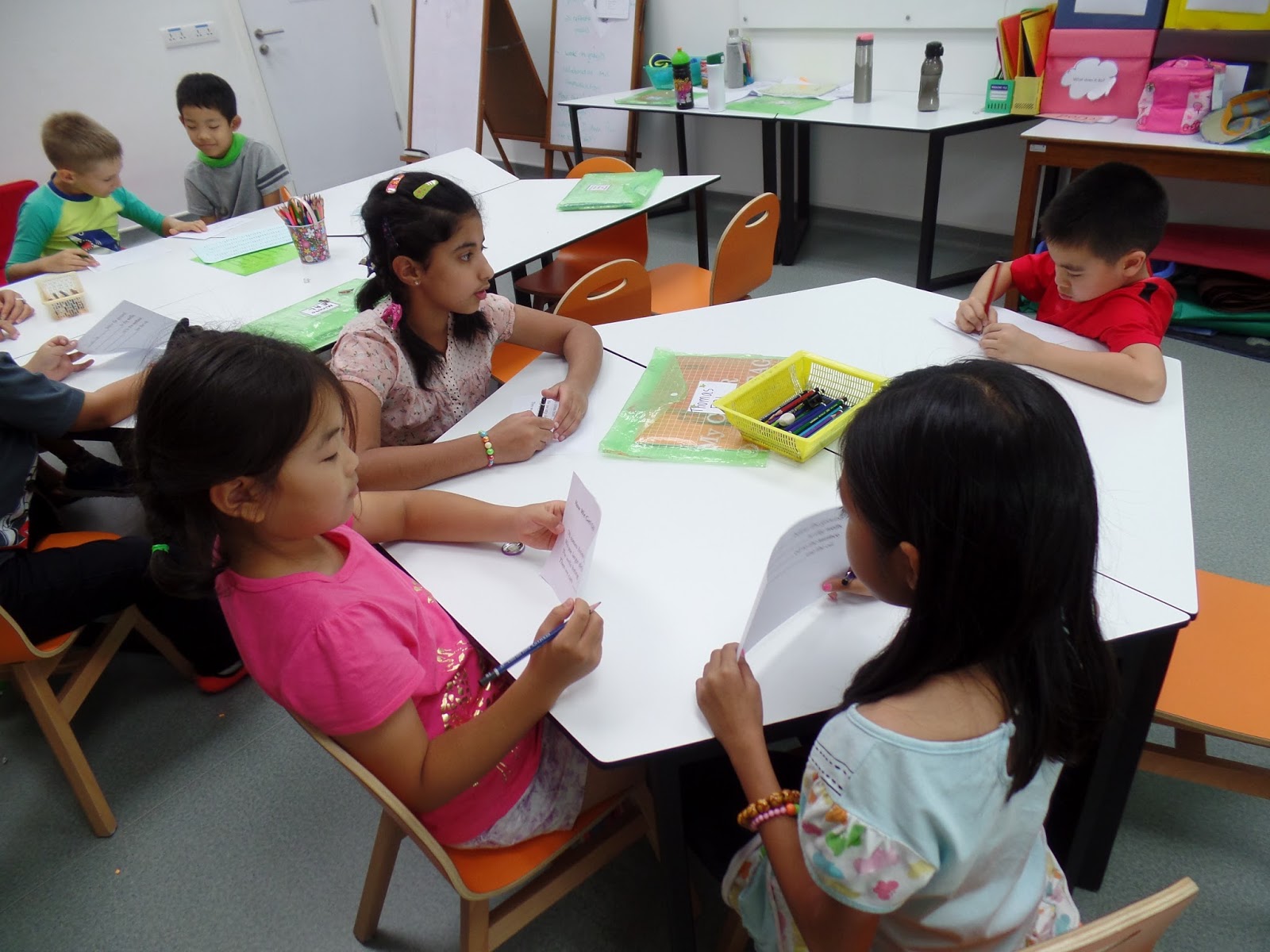
During the EFL classes we read several books about staple crops and grains. My Grade 2 ELLs focused on comprehension activities and we practiced drawing conclusions, identifying important facts and making connections. We also had a Think-Pair-Share session, where the children had to discuss and compare how rice, oats and wheat are grown.

KimVeng, Hailey, Alicia and Maly presented their findings about how rice is grown.

EAL in Grade 3

During in-class EAL support with my Grade 3 ELLs we enjoyed creating limericks and performing them for the rest of the class. At first my students were not sure that they could create their own limerick, but after a couple of attempts they became very confident and had a lot of fun discussing characters and making sure their limericks made the others smile.

Miss Michelle's students creating limericks.

In EFL class we read books about performing and created shadow puppet skits.
Sofia, Thomas and Rothida performed a short story about a dog, a bird and a butterfly.
Jan and Minato are performing.
We also discussed the fact that only 15% of communication is verbal and the rest we understand from facial expressions and body language. My students thought it was an important piece of information for them as performers.

We also read a book about stage fright and learned about strategies to overcome it.

My Grade 3 ELLs discussing how to overcome stage fright.
EAL Beginners

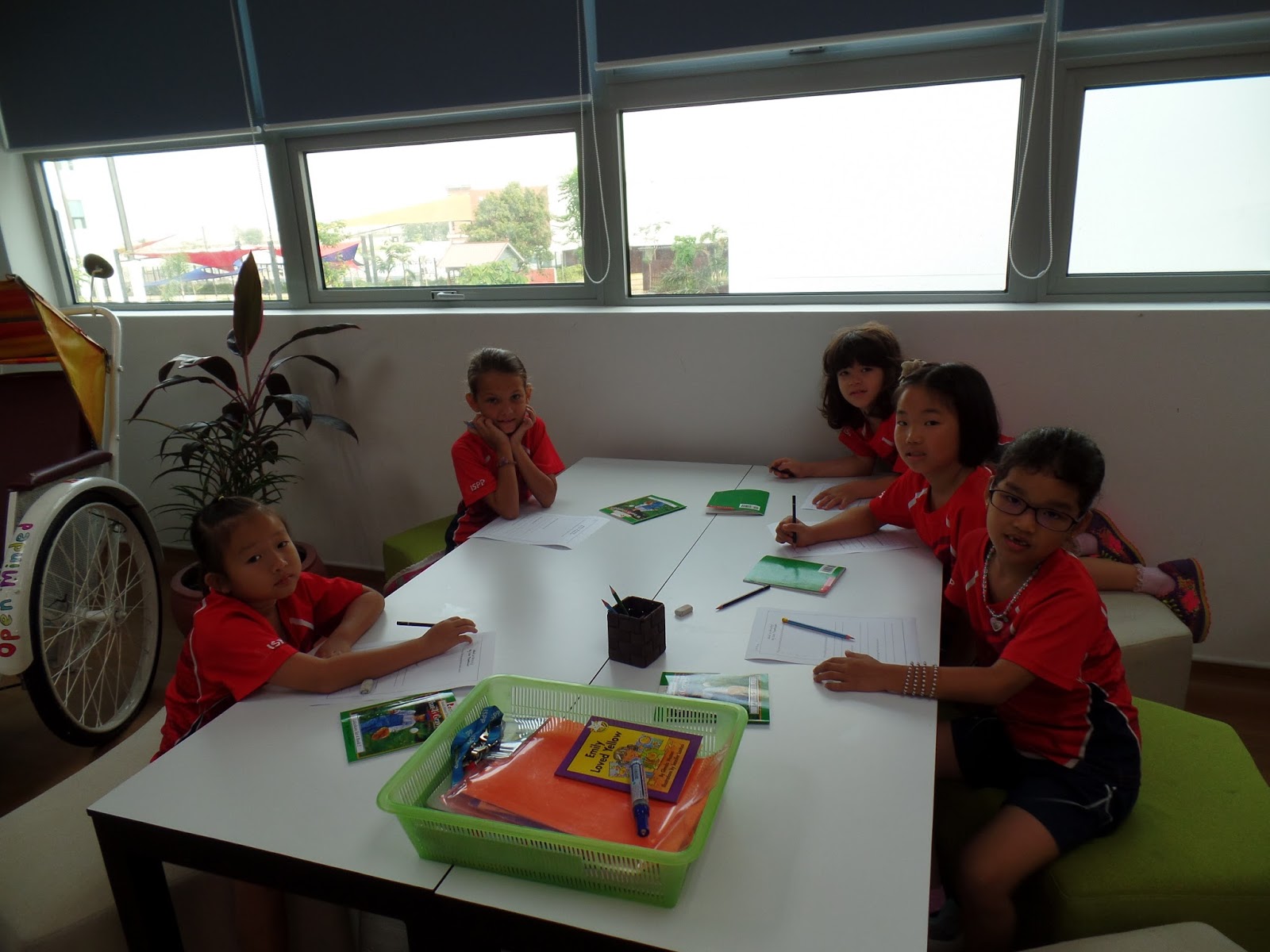
Both of my groups of beginners continued to work hard developing their reading and thinking skills, discussing characters and analyzing their actions, predicting events and discussing the main idea of the story. 

Alicia and Hailey are the leaders in the group.

Reading books together and discussing them is fun!

Sunday, May 1, 2016


One more week just flew by and as always it was full of great activities and amazing learning.


G2 In Class Support

Hailey in Miss Courtney's class is learning about where rice grows.

Our Grade 2 students are learning about staple crops. Living in South-East Asia and in Cambodia provides us a lot of opportunities to learn about rice. Our kids demonstrated a lot of curiosity and asked many questions about rice and how it is grown. All those questions guided our research and all the children created very informative posters about rice. I had to support the ELLs and some mainstream students through this project developing their research, communication and thinking skills. We were learning new vocabulary, and practiced using it during big and small group discussions. 

Sak is creating his poster about rice in Miss Anita's room.
Samir and Sorriaj are learning about rice and other grains in Miss Karyn's room.

G3 In Class Support


The activity of this week was the running dictation of limericks. Our G3 students had to work in pairs - one student ran up to the limerick display, memorized a line from the limerick and ran back to their partner to dictate it. Next they had to practice performing the limericks in front of the whole class. We all enjoyed a bit of running but mostly performing with our friends. Speaking, reading, listening, writing skills were practiced during this great learning experience.


Yubin and Dahee are practicing their limerick.


Jade and Mahin are practicing their limerick.


EFL Classes

In my EFL classes, the G2 students were creating mind maps and discussing RAZ books related to our unit "food as a resource" theme.  We had discussions about how and where crops grow. We read several non-fiction books and learned how to extract interesting and important facts from the text.

My G3 ELLs watched several videos with performances and produced a concept map about what performance is. We also listened to a podcast about sea turtles and my students had to create a skit in groups. The message of the performance was to protect sea turtles. My students were very excited during the activity and most of the skits were very successful. 


Sunday, April 24, 2016

We all had a week long holiday and came back to school relaxed, full of impressions and ready for learning and having fun with friends and teachers.

In Class Support

Both Grade 2 and Grade 3 started their new units. It is one of the most exciting phases of the inquiry process, as our students share their wonderings with us about the theme of the unit.
In Grade 2 we began to discuss food as a resource. We began introducing our students to the new vocabulary of the unit and I prepared several activities for the whole class. In order to set the mood and give our students some food for thought we watched a video about World Hunger and Food Waste. A meaningful discussion took place after we finished watching the video. The targeted language was used again and again during this discussion. After that the children were involved in a cooperative learning activity. I chose six new words to focus on and all the students worked in six groups. Each group received cards with the word and definition and the word and image. The task was to discuss the cards with their parters and on an A4 sheet of paper write down the various connections they could make and come up with several wonderings. We worked in mixed ability groups and EELs had plenty of support from their peers. In the end of the session we shared our connections and wonderings with the rest of the class, while sitting in a circle on the carpet. We all enjoyed the activities and all the students had multiple opportunities to construct their understanding of the new words and practice the new language of the unit.
Kim Veng, Lukas and Erika were learning together.
Alicia actively participated in the discussion when learning with and from her peers.

While planning together with the Grade 3 team we decided to do the Color Symbol Image thinking routine with our students. Following Kath Murdock's recommendations we asked each student to complete his or her own CSI chart. The word in focus was PERFORMING. In the end of the session we all had a chance to share our thinking and perceptions with the rest of the class. This class was very insightful and we learned a lot about each other. For some people dancing was flowing like blue water and for others dancing was like hot red lava. Our Grade 3 kids came up with fascinating and wonderful symbols some of them common and some of them quite unique.

Yubin chose a yellow color for PERFORMING because yellow is a happy color.
Sharing in Miss Lisa's class was a great time for teamwork and even the shy team members spoke.
EFL Classes

In our EFL classes we began the week with reflecting on our holiday. My ELLs had to recollect their holiday experiences, plan their writing, write about their holiday and illustrate their writing.

We also began to think about our units and create concept maps and discuss our prior knowledge.

On Earth Day we listened to a podcast about water pollution and answered comprehension questions. 

EAL Beginners

We continued reading books  and developing our literacy skills in a small group of EELs. 

We discussed the main idea of the book and the importance of the author's message. My students practiced making connections to the unit theme, reading out loud and giving reasons for their opinion. 

We also enjoyed retelling the story at the end of the class and were proud that we remembered all the characters. 

Our plan for the next session is to make puppets and act out the story.

Sunday, March 27, 2016

In CLASS

This week my Grade 2 students were busy reading more about simple machines and doing experiments. 

All the children were really engaged in the experiments. They made their discoveries and shared their findings with their peers. They also had a chance to share their learning with each other.


Visal and Jayden were learning about the weight arm and force arm using a ruler and a bean bag.
Samir, Kim Veng and Sorriaj were learning about forces.

In Grade 3 we were all practicing "The Recycling Maniacs" play.

It was a parallel teaching session and it gave the classroom teachers and me a chance to work on our team skills. At the beginning our students had to decide who will do what and choose the parts. It became obvious who learned to compromise and who still needs to practice. After sorting out the parts the players had to read the parts and think creatively about acting out certain moments. During this activity the children had a chance to lead if they had a valuable idea and to follow when it was time to agree with their peers. It was exciting to observe the ELLs as they were all very enthusiastic about participating in the play but chose the shorter parts.

In each classroom I worked with two groups and both groups had enough time to practice the play and then presented to the other group. The change of the roles was useful, as while being part of the audience, students were able to provide much needed feedback to the other group. It helped our learning process and we practiced speaking and expressive skills, listening and critical thinking skills, communication skills in general and team building skills. Great learning experience in one session!

Miss Lisa's girls were led by Monica  and everyone enjoyed practicing.
Oceana and Olivia were the stars as always.
EFL CLASSES

In  order to support the learning that took place in class I thought it was important to focus on listening and speaking skills in my EFL classes. With my Grade 2 students  we read comprehension texts about simple machines and completed listening cloze activities. At the end of the week we created a mini book  about simple machines  and had to write a blurb about the author on the back of the cover.

Samir is proud of his mini book!
Mollymoon enjoyed creating her book.
My Grade 3 ELLs were also busy with the listening cloze and even the beginners learned how to do it. The highlight of the week was our listening to podcast activity when we listened to the Shilah story. It is a short story about the seal that suffered from the oil spill but was saved by people. My students had to answer the questions and had a discussion about oil spills.


EAL BEGINNERS

It was a productive week for my beginners group where we continued our guided reading sessions and had meaningful discussions of the author's message and the moral of the story. The stories that we are reading are easy ones, however, it was a bit challenging for my EAL beginners to unpack the message and say what they learned from the stories.

The story abut Morty the bear taught us to be happy with what we have.
The best class of the week was when we read a non-fiction book. My students were very interested to learn facts about animals that look alike but actually are different animals.
We talked about interesting facts and important facts and tried to memorize important facts to teach our friends and maybe even parents. Do you know the difference between a crocodile and an alligator or a turtle and a tortoise? Ask Jade, Yubin, Sofia or Thomas and they will teach you!

Saturday, March 19, 2016

In Class Support

This week our Grade 2 students were performing experiments and making attempts to apply their theoretical knowledge about inclined planes to practical usage.

The goal of the experiment was to move the boiled egg from the seat of the chair to the floor without breaking it. The activity really worked well and could be a great example of cooperative learning. During the process our ELLs worked in mixed pairs and had a chance to practice the academic language of the unit, share their thinking and practice resilience (when things did not go well after the first attempt). All students had to be active listeners and effective communicators to achieve their goal.

Kim Veng and Sorriaj  were very successful in their experiment and their egg landed safely in the cushion of tissues without a single crack.
In Grade 3 our students continued to work with the vocabulary of the unit. While planning with the Grade 3 team we invented an activity that we called "Talk Time". On Friday students worked in small groups, each group received cards with unit words and images. The task was for each member of the group to talk about the card for 1 minute (or 30 seconds).

Our students in Miss Claire's class decided to turn it into a guessing game without telling the word to the rest of the group.The whole group had to listen carefully to the description and then guess what the word was.

We had lots of fun and had a good practice of the unit words. Our students said that it was challenging to talk non stop for 30 seconds and also admitted that they are still not knowledgeable enough about certain words. We will make sure that we will do this activity again later.

Arvid's group enjoyed the "Talk Time" activity, listening, presenting and timing each other.

EFL Classes

The highlight of this week for our Grade 2 EFL group was the Split Dictation activity.
Boys and girls had to work with a text about simple machines. While working in pairs my students displayed great social and communication skills. They had to accept responsibility and adopt various roles to be able to effectively complete the activity.

Bravo Grade 2!!
During our Grade 3 EFL classes this week we began to read the book about oil (Messy Resource) and completed a listening cloze. The students demonstrated good communication and cooperation skills, learning a lot from their peers.

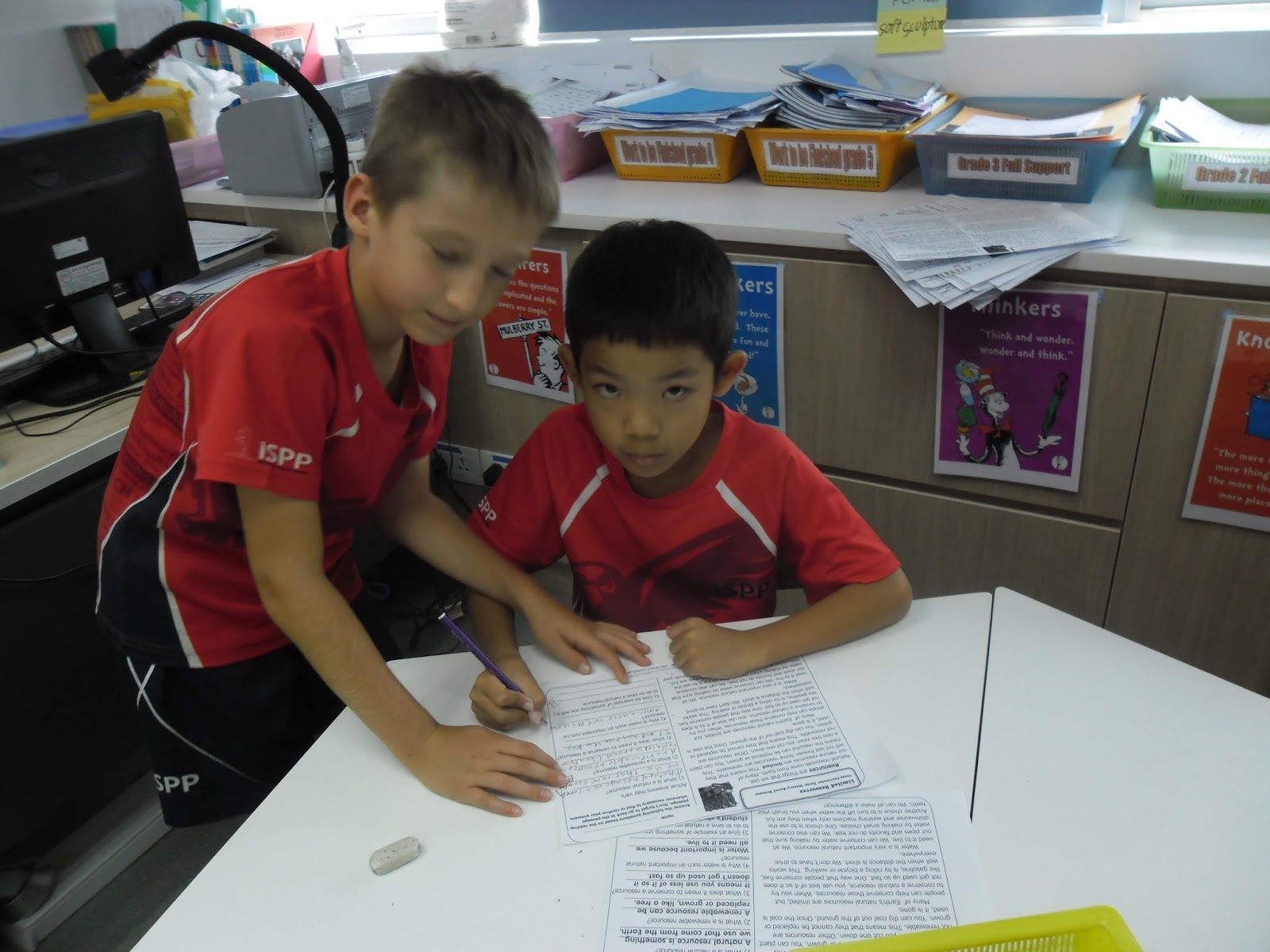
Jan worked with Minato and supported him a lot.

Thida and Yubin also worked very effectively together.

EAL Beginners

We continued our guided reading sessions with the Grade 3 beginners this week.  We talked about the structure of the story, created mind maps, discussed favourite characters and wrote a summary. I am sure the best class of the week was when we acted out the "Henny Penny" story with puppets.

Girls are creating mind maps.

Sofia had the part of Henny Penny.

Sunday, March 13, 2016

In Class Suport


Mollymoon, Maly, Alicia, Hailey and Sonita had great time reading and  discussing gravity.
My Grade 2 EAL students continued exploring the world of simple machines. We started the week with a field trip to a playground. The children talked a lot about the simple machines that they saw (or thought that they saw) at the playground. They were exchanging their guesses, experiences and ideas. Lots of active listening occurred as the students were genuinely interested in the subject of discussion and exchanged their background knowledge eagerly.


We also continued our guided reading sessions with small groups of grade 2 students. Because of the nature of the unit we read a lot of non-fiction books about simple machines. In Miss Courtney's class we had an interesting discussion about gravity and thought about why gravity is important and what helps us to overcome it.

In Grade 3 we were busy discussing the new vocabulary and practicing procedure writing this week. Our team chose the Stir - the - Class activity to begin the vocabulary discussion.
In every class our students worked in five groups and each group had an image and a definition to talk about. Students practiced sharing their background knowledge, their guesses, and thoughts in general about the word in focus. After 5-7 minutes one student left his/her group and joined the next one. That gave students multiple opportunities to talk about the words. Unavoidably our Grade 3 students had to be repetitive and had to be an effective communicator and active listener and practice over and over again. We all enjoyed the activity and our real challenge was discussing nuclear energy because of the complexity of the process.
Miss Claire's students were enthusiastic thinkers!


Miss Lisa's students learned a lot from each other.
In Miss Michelle's class we have a lot of effective communicators.

EFL Classes

While learning about simple machines with my Grade 2 ELLs we watched several videos during this week and completed several comprehension activities. We went over the concept of function again and again to ensure the deep understanding of simple machines that we have discussed so far. We worked in pairs and small groups, asking and trying to find the answers to the questions: What is an inclined plane (or wedge, screw, etc)? How does it work? How this simple machine is used? What does this simple machine helps us do?

It was exciting to observe my students making their own"discoveries", learning that a screw is a wedge with an inclined plane wrapped around it. 

Maly and Molymoon learned that an inclined plane is made of two wedges.

In Grade 3 we continued learning about procedure writing. At the beginning of the week I modeled a short procedure writing exercise for my group. We watched videos about how things are made and read books about it. Next it was time for guided procedure writing. I prepared a text about paper making for my students and asked them to use one color to highlight the material we need to make paper and another color to highlight the steps that should be followed. We filled in the text organizer for procedure writing with words and phrases.

Finally my students had to write the final procedure of how to make paper, using their text organizers, forming sentences and adding time connectives to sequence the steps.

Yubin was the first one to complete the task! 

Sunday, March 6, 2016

In Class Support

After analyzing my student's individual language needs I decided that now we need to focus on the reading and comprehension skills of our ELLs. I shared my ideas in our planning meetings with the Grade 2 and Grade 3 homeroom teachers. 

In Grade 2 this week I worked with various groups of students building up their reading skills. 

In Miss Courtney's room we read a book about simple machines, created mind maps and then shared them with the rest of the class.

Hailey, Mally, Mollymoon and Yi Lei shared with their peers what the book was about.

In Miss Anita's room we read a book about inclined planes in a small group and had a meaningful discussion about our previous knowledge and what we learned. We made connections and found out the meaning of some challenging vocabulary.

Rachael was our scribe and put our ideas down on a poster.

In Miss Karyn's room we also read a book about inclined planes with KimVeng and Sorriaj and focused on the concept of function. Both boys successfully practiced a discussion about  inclined planes using the academic language of the unit.

In Grade 3 we focused on pre-assessment activities and selecting the vocabulary that we will have to learn during the unit. In all three classrooms the students had to listen to songs about natural resources and create a list of vocabulary to focus on during the unit.
Our plan is to use the words selected by the students for the Stir-The-Class vocabulary activity next week.

Miss Lisa's class is getting ready to listen to the song and to watch the clip.
Another highlight of this week in Grade 3 was the sharing session with parents. I helped Mahin and Thomas to get ready for talking with their parents.

Mahin is thinking what things her family is reusing and recycling.

Developing Reading Skills with EAL Beginners

This week we had several guided reading sessions with my Grade 3 beginners. 
The mind map from last week proved to be a great tool and helped us tremendously to retell the story without reading it again.

We read a new story about a giant pumpkin and managed to learn more about story structure and how to write a summary. We also made predictions and connections and, as usual, practiced reading out loud.

Yubin is sharing her written summary with her peers.
EFL Classes

My Grade 2 ELLs were thinking and learning about simple machines this week. The concept in focus was function.

We had a great time practicing a matching activity on MIKIDS.com and learned a lot.

We also had a very successful lesson learning about an inclined plane. We watched a video, read a teaching text and had to answer questions and also draw how people use inclined planes.

Miss Kim supported Haily during this activity.
My Grade 3 ELLs were very enthusiastic this week and accomplished a lot. We practiced a sorting out activity where we had to write down a natural resource on a post-it note and then place it under the RENEWABLE or NON-RENEWABLE headings.

Non-renewable resourses were posted on the red poster.
Renewable resources were posted on the green.
My Grade 3 ELLs also practiced doing a comprehension activity and learned a lot about natural resources and how to answer the questions that follow a non-fiction text. My students had to re-read the text to find the right paragraph and use the information for their answers. It was not an easy task and I enjoyed observing a lot of cooperation between the students.

Jan is eagerly helping Minato and explaining to him were to find the correct answer.
We also discussed how things are made and learned about the fact that many things around us are made from natural resources. We watched a video about how scissors are made and found out that steel is a metal and it comes from rocks. Next my students had to continue learning in four groups. The objects that they had to explore were a pencil, a crayon, a metal paper clip and a book. My students had to match natural resource cards with their object, to explain what they were made of. 

All my Grade 3 children were very involved in this activity and made a lot of discoveries and shared a lot of hypotheses with each other. Finally the groups presented their findings and were very satisfied with the learning that took place during this class.

Jade's team learned about what natural resources are used to make crayons.
Yubin and Juliana learned about what natural resources we use to make pencils.
Mahin's team presented their findings about what what natural resources are used to make books.
Jan's group presented what natural resources are used to make paper clips.