Sunday, March 6, 2016

In Class Support

After analyzing my student's individual language needs I decided that now we need to focus on the reading and comprehension skills of our ELLs. I shared my ideas in our planning meetings with the Grade 2 and Grade 3 homeroom teachers. 

In Grade 2 this week I worked with various groups of students building up their reading skills. 

In Miss Courtney's room we read a book about simple machines, created mind maps and then shared them with the rest of the class.

Hailey, Mally, Mollymoon and Yi Lei shared with their peers what the book was about.

In Miss Anita's room we read a book about inclined planes in a small group and had a meaningful discussion about our previous knowledge and what we learned. We made connections and found out the meaning of some challenging vocabulary.

Rachael was our scribe and put our ideas down on a poster.

In Miss Karyn's room we also read a book about inclined planes with KimVeng and Sorriaj and focused on the concept of function. Both boys successfully practiced a discussion about  inclined planes using the academic language of the unit.

In Grade 3 we focused on pre-assessment activities and selecting the vocabulary that we will have to learn during the unit. In all three classrooms the students had to listen to songs about natural resources and create a list of vocabulary to focus on during the unit.
Our plan is to use the words selected by the students for the Stir-The-Class vocabulary activity next week.

Miss Lisa's class is getting ready to listen to the song and to watch the clip.
Another highlight of this week in Grade 3 was the sharing session with parents. I helped Mahin and Thomas to get ready for talking with their parents.

Mahin is thinking what things her family is reusing and recycling.

Developing Reading Skills with EAL Beginners

This week we had several guided reading sessions with my Grade 3 beginners. 
The mind map from last week proved to be a great tool and helped us tremendously to retell the story without reading it again.

We read a new story about a giant pumpkin and managed to learn more about story structure and how to write a summary. We also made predictions and connections and, as usual, practiced reading out loud.

Yubin is sharing her written summary with her peers.
EFL Classes

My Grade 2 ELLs were thinking and learning about simple machines this week. The concept in focus was function.

We had a great time practicing a matching activity on MIKIDS.com and learned a lot.

We also had a very successful lesson learning about an inclined plane. We watched a video, read a teaching text and had to answer questions and also draw how people use inclined planes.

Miss Kim supported Haily during this activity.
My Grade 3 ELLs were very enthusiastic this week and accomplished a lot. We practiced a sorting out activity where we had to write down a natural resource on a post-it note and then place it under the RENEWABLE or NON-RENEWABLE headings.

Non-renewable resourses were posted on the red poster.
Renewable resources were posted on the green.
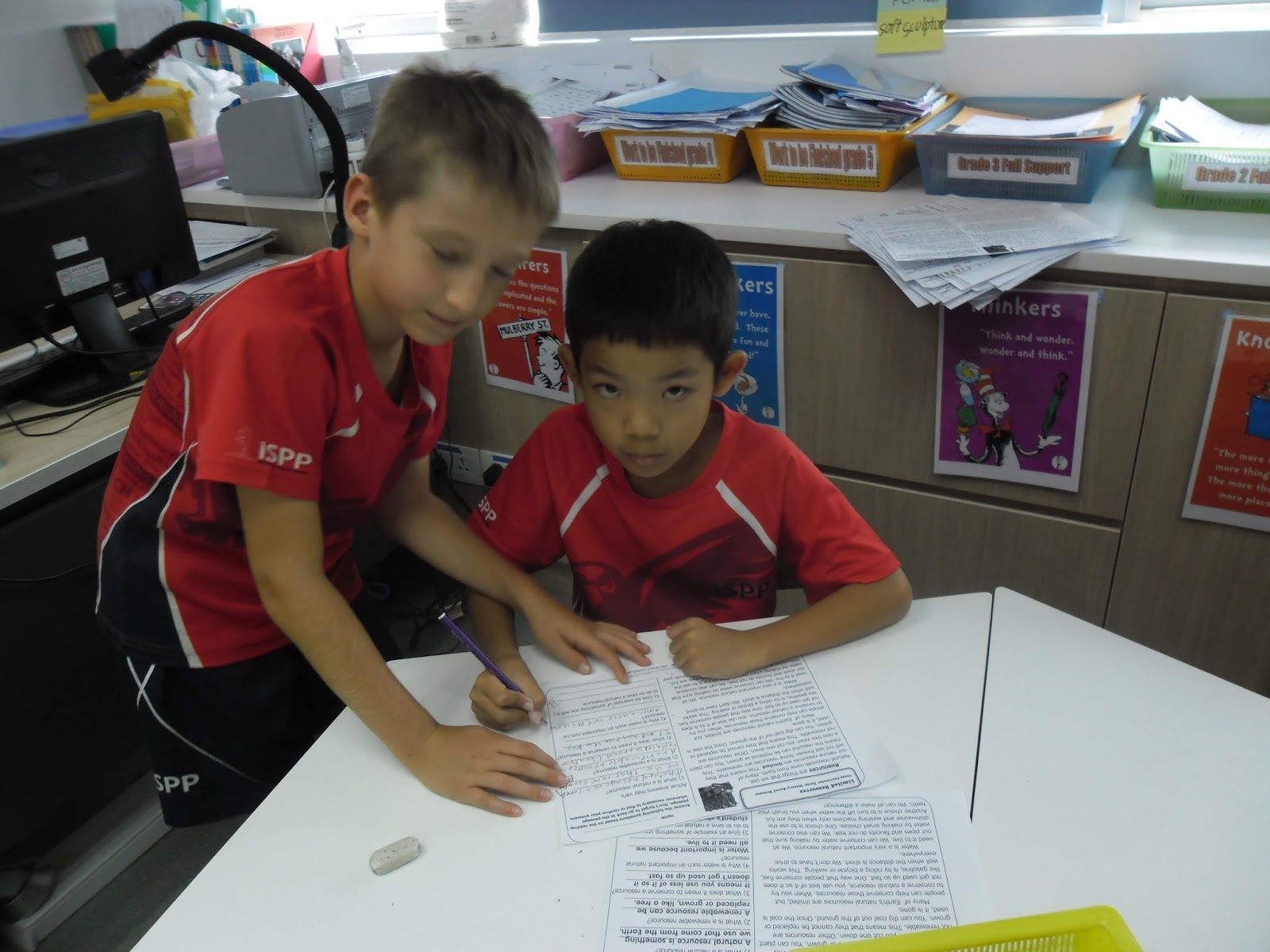
My Grade 3 ELLs also practiced doing a comprehension activity and learned a lot about natural resources and how to answer the questions that follow a non-fiction text. My students had to re-read the text to find the right paragraph and use the information for their answers. It was not an easy task and I enjoyed observing a lot of cooperation between the students.

Jan is eagerly helping Minato and explaining to him were to find the correct answer.
We also discussed how things are made and learned about the fact that many things around us are made from natural resources. We watched a video about how scissors are made and found out that steel is a metal and it comes from rocks. Next my students had to continue learning in four groups. The objects that they had to explore were a pencil, a crayon, a metal paper clip and a book. My students had to match natural resource cards with their object, to explain what they were made of. 

All my Grade 3 children were very involved in this activity and made a lot of discoveries and shared a lot of hypotheses with each other. Finally the groups presented their findings and were very satisfied with the learning that took place during this class.

Jade's team learned about what natural resources are used to make crayons.
Yubin and Juliana learned about what natural resources we use to make pencils.
Mahin's team presented their findings about what what natural resources are used to make books.
Jan's group presented what natural resources are used to make paper clips.

Friday, February 26, 2016


EFL Class

I just recently learned about the Learn Reflect Share visible thinking routine and decided to practice it during my grade 2 English as Foreign Language lesson. My students had to answer two questions about what they learned and why it was important for them. The third question was about what their friends learned. Children had to work in pairs and ask each other to fill in the answer to the last question.

I prepared a substitution table for my beginners with some words and expressions for them to use when building their sentences. My intermediate ELLs used the same scaffold but only for ideas as they had enough language to express themselves.

It was a good choice of activity and my scaffolds worked well. Most importantly it was at the right level and my children felt confident and comfortable doing it.

In the end we had a sharing circle and everybody had a chance to exchange what they and their friends learned during this unit.

Mollymoon and Maly were parters and enjoyed learning and sharing.

Kim Veng is  waiting for Sak to come back and continue. Samir and Jayden, Maly and Mollymoon were partners

Developing Reading Skills with EAL Beginners

We continue to develop the reading and thinking skills of our EAL beginners in Grade 3. Today we had a very productive guided reading session. We read a story about a boy in a wheelchair and my students were quick to make connections to children's rights. One of the guest speakers during the unit talked about the rights of disabled children and our students learned a lot and were very impressed.  

First we discussed the cover and talked about the author and the illustrator. We also looked at the pictures and made predictions about the story.  After that we read the story taking turns and stopping to discuss unfamiliar words or interesting or challenging ideas. Next we talked about how to make retelling easier and what tools can we use. We discussed mind maps and how to make them and decided to make one. Most of my beginners never had a chance to make a mind map so I modeled it for them. We talked briefly about what a symbol is and how to use it in your mind map. Finally our mind maps were ready and we practiced a shared retelling. All my students were engaged in this activity and even those that were shy had to speak and share their thinking about the story. We also practiced reading out loud and the students greatly benefited from this.

We all enjoyed our class. My plan for the next session is to ask my students to retell the story with the help of their own mind map. We will see how they manage.

Jade was the first one to make the connection between the story and our unit about children's rights.

In Class Support

This week was like harvest time both in Grade 3 and Grade 2 as we enjoyed the last week of our units, sharing with peers and parents, and reflecting on our learning and teaching.

In Grade 2, I supported my EAL students while they were getting ready for the summative assessment presentations and sharing sessions. 

Miss Anita's students are creating their posters.

Visal researched old and new trains in Cambodia.


Maly is writing her reflection with two stars and a wish.

In Grade 3 our ELLs were involved in cooperative practicing of their presentations and creating their Google doc. reflections.

Miss Michelle's students enjoyed cooperative learning.

Yubin and I are making sure everything is just right on the poster.
Yubin and Dyna are typing in their reflections.

Friday, February 19, 2016

In Class Support


Jennifer shared some good thinking while working on her summative task.
This week my Grade 2 students were working on their summative assessment, reflecting on how their new knowledge about artifacts helped them to understand the history of Cambodia.


The Grade 3 students had an adventurous week of filed trips and action taking. One of the field trips was to CCF (Cambodian Children Fund). ISPP Students learned a lot about how CCF helps the community and took action, donating clothing to the fund.


My EAL beginners had lots of fun presenting 'The Turnip' story. We read 'The Turnip' story and decided to act it out. Sofia ended up having two parts - the Cat and the narrator. All my students enjoyed the activity and practiced being expressive and loud and clear when speaking. Our plan is to have even more fun with 'The Mitten' story next week.

Minato - the Man, Yubin - the Woman, Thomas - the Dog, Sofia - the Cat and the  Narrator, Thida - the Mouse

I had an opportunity to work one on one with my beginner Grade 3 student Yubin. We worked on Yubin's reading comprehension skills. Yubin read a story about a Dragon with a cold. Before reading I talked to Yubin about the cover, title, the author and the illustrator. Yubin made her predictions about the story. During the reading we stopped several times to discuss the new words or just the meaning of the challenging passages. Yubin enthusiastically answered my questions about the characters, setting, problem and solution.

She managed to make a personal connection to the text. Finally we learned about what is a summary and how to write it. In this video Yubin is answering my questions about the story and reads the summary of the story that we completed during this session.


EFL Classes

During the EFL classes this week my Grade 2 students were creating ISPP timelines. Boys and girls had to work with a partner from their classroom as the plan was to take the completed ISPP Timeline back to the class and share it with their peers.

My students had an opportunity to discuss and compare photographs, sequence them and enrich their knowledge about the history of our school. It was exciting to observe them making their discoveries and hear their enthusiastic comments. It was a loud class and we all talked a lot with each other. The next step will be to practice presenting our timelines.

Sak and Jayden worked really well together.

Maly and Mollymoon are sorting out the images before pasting them on the timeline.

Sunday, February 14, 2016

EFL Classes This Week


My G2 students continued presenting their posters about Cambodia this week.
We all were impressed with the collaboration between the children. Alicia and Kim Veng formed a team and their presentation was really good. Samir worked with Jennifer and both of them demonstrated a great choice of strategies. Samir chose to lead in this activity and supported Jennifer where it was needed. Hailey, with her limited English words and expressions was a real risk-taker and faced the challenge of presenting in front of the group. Visal missed a couple of classes and had to work hard to catch up with the rest of presenters. However, his presentation about the Khmer language was one of the best.


Jennifer and Samir are speaking about Khmer celebrations
.
Alicia and Kim Veng are speaking about Khmer houses.

Visal is speaking about the Khmer language.

Hailey  is speaking about land in Cambodia.


We also read several non-fiction texts about Cambodia and completed a cloze activity.


Further exploring the theme of rights and responsibilities, my G3 EFL students read "The Turkey Girl", a native American folk story.

I wanted my children to interact with the text, activate their prior experience and be able to employ the four strategies : generating questions, summarizing,  clarifying, and predicting. That is why I chose the reciprocal reading strategy. I wanted my EAL readers to construct meaning from the text by relying on prior experience to parallel, contrast, or affirm what the author suggested. Without meaning construction, learning does not take place. 

In order to more effectively support our students we created three subgroups within our EFL G3 group. My TA, Ms. Kim, worked with Minato and Zereach, I worked with my Korean students Yubin and Thomas using the modeling and bridging scaffolding strategies to support them, while the rest of the students worked independently. We all also used the "Think Aloud"strategy to make students aware of their own thinking processes while speaking, reading and writing.


In Class Support

My Grade 2 students continued their research about artifacts, practicing the academic language of the unit and thinking about timelines. In Miss Courtney's classroom the children worked with the National Museum Artifacts. In Miss Anita's room the students had a unique chance to learn about Miss Anita's family history and timeline and use family souvenirs for their research.

I was using the modeling and contextualization scaffolding strategies to help our students make connections between themselves and the content of the research and support them in this learning experience.


Sak is presenting the results of his research.
In Miss Claire's Grade 3 classroom we had a great collaborative teaching session. Our students were able to create persuasive posters with strong images, using persuasive sentence starters. All our students had a chance to analyze the presented posters and discuss the persuasive elements used by their peers.


Arvid was very expressive presenting his poster.
In Miss Lisa's classroom I worked with the EAL learners supporting them in their task to create a script for their puppet video. Yubin and Dyna created puppets of children and their next step was to think of dialogue about children's rights. They chose to discuss the right to have a family. I was using modeling, bridging and primary language support scaffolding strategies. I modeled dialogue writing and helped my students to activate their prior knowledge relevant to the unit theme. I also encouraged Yubin and Dyna to have a meaningful discussion of the right in focus and make personal connections.  

Both Yubin and Dyna enjoyed writing the script.